 Claude
 Perplexity
TL;DR
- For Dubai homeowners, tenants, villa owners, and property managers who want to understand why mattress hygiene deserves more attention than it typically gets, and how professional cleaning addresses problems that regular vacuuming cannot.
- Dubai's heat and humidity can contribute to dust-mite and mould problems when indoor humidity is high, though air conditioning may reduce it, so conditions vary by home.
- Professional cleaning can remove more dust, debris, stains, and allergens from the mattress surface and accessible layers than routine household cleaning.
- Knowing which mattress problems can be handled at home and which require professional intervention prevents wasted effort and unnecessary damage.
- Scheduling professional mattress cleaning on a routine basis, rather than only when stains appear, is what actually protects sleep quality and indoor air over time.
Despite being used for about one-third of the day, a mattress is one of the few areas in most Dubai homes that is not cleaned regularly. Bed sheets are changed once a week. Mattresses tend to be slept on for several years. Professional mattress cleaning helps remove accumulated dust, sweat residue, allergens, and other contaminants that routine surface cleaning may not remove effectively. This article explains what builds up inside a mattress, why some Dubai homes may experience faster dust and allergen buildup, and when professional cleaning may be more appropriate than routine vacuuming.
Also Read
What actually builds up inside a mattress
A mattress is not a static object. It is a layered, absorbent structure that continuously collects material from the person sleeping on it.
Over the course of a year, a mattress absorbs sweat, body oils, dead skin cells, and airborne dust that settles through the fabric weave. Dead skin cells in particular are the primary food source for dust mites, microscopic organisms that live in soft furnishings and thrive on organic debris. Dust mites do not bite or carry disease, but their waste particles are a well-documented allergen trigger, contributing to sneezing, congestion, itchy eyes, and disrupted sleep in sensitive individuals.
None of this is visible during a casual inspection. A mattress can look entirely clean while holding a substantial population of dust mites, along with the moisture and organic matter that sustain them. This is precisely why mattress cleaning tends to be neglected: there is rarely a visual cue prompting action. You can read more about how hidden allergens accumulate in Dubai soft furnishings through the same mechanism.
Why Dubai's climate makes this worse
Dust mites generally thrive in warm, humid environments, with higher indoor humidity supporting their growth. Some Dubai homes can maintain warm and humid indoor conditions, especially when humidity control is poor, creating an environment that can support dust mites.
During sleep, the body releases moisture through breathing and perspiration. In a poorly ventilated room, that moisture can contribute to higher indoor humidity, although air conditioning may remove some of it. Outdoor humidity can also affect indoor conditions, particularly in coastal parts of Dubai. Indoor humidity varies depending on air conditioning, ventilation, and humidity control, so conditions differ from home to home.
Fine dust entering through doors, balconies, ventilation systems, and normal household activity can settle on fabrics and bedding, including mattresses. You can read more about how Dubai dust affects soft furnishings and why standard surface cleaning often falls short. Homes with poor ventilation, inadequate filtration, or limited humidity control may accumulate dust and allergens more quickly than homes with well-maintained HVAC systems.
Why vacuuming and sunlight are not enough
Vacuuming is a good maintenance practice and helps remove surface dust. However, dust, skin particles, and allergens can become trapped within the mattress's fabric and padding, beyond what routine surface vacuuming can effectively remove.
Sunlight and dry conditions may help reduce moisture on exposed surfaces, but they should not be treated as a substitute for proper mattress cleaning. In Dubai, outdoor humidity and practical limitations in apartments can make outdoor drying difficult. For residents in high-rise buildings, taking a mattress outside for sun drying is simply not practical. During humid weather, outdoor air may not provide the dry conditions needed for effective drying, particularly in coastal areas.
This is where professional mattress cleaning can be useful. Professional technicians bring equipment and cleaning methods that go beyond routine surface vacuuming.
How professional mattress cleaning actually works
Professional mattress cleaning generally combines several stages, each targeting a different layer of contamination.
Inspection and pre-treatment. A technician first assesses the mattress type and condition. Memory foam, latex, and traditional spring mattresses respond differently to moisture and heat, so the approach is adjusted accordingly. Visible stains are pre-treated before the main cleaning begins.
High-powered extraction vacuuming. Professional-grade vacuums with HEPA filtration are substantially more powerful than household units. This step pulls dust, dead skin, and loose allergen particles from deeper within the mattress surface than a standard vacuum can reach.
Hot-water extraction or low-moisture steam. These are different methods, and the appropriate one depends on the mattress material, condition, and the provider's equipment. Low-moisture steam methods can deliver heat while limiting the amount of moisture introduced into the mattress, which reduces the risk of slow drying and mould growth in humid conditions. Effectiveness depends on the temperature, exposure time, and whether the heat actually reaches the affected area.
UV-C sanitisation (where offered). Some services use UV-C light as an additional treatment step intended to reduce microorganisms on directly exposed surfaces. Its effectiveness depends on UV intensity, exposure time, distance, and direct exposure to the surface.
Drying. After cleaning, technicians should use appropriate airflow and drying methods to ensure the mattress is completely dry before use. Drying time depends on the cleaning method, mattress material, humidity, and ventilation. If you are weighing options, see our guide on cleaning a mattress at home for a comparison of what DIY care covers.
DIY mattress care vs. when to call a professional
Homeowners can reasonably manage some aspects of mattress hygiene between professional cleanings. Others genuinely require professional equipment.
What can be handled at home:
- Weekly vacuuming of the mattress surface using a vacuum with strong suction
- Rotating or flipping the mattress every few months, where the mattress type allows
- Using a washable, allergen-proof mattress protector
- Spot treating fresh, minor spills immediately with a clean cloth and mild solution
- Maintaining good ventilation and using air conditioning or dehumidification when indoor humidity is high
When professional cleaning or assessment may be appropriate:
- Deep-set or old stains that may benefit from professional stain-treatment methods, though complete removal cannot always be guaranteed
- Persistent odours that vacuuming and surface cleaning have not resolved
- Visible mould: this should not be treated by adding more moisture to the mattress. If mould has penetrated the mattress, professional assessment or replacement may be more appropriate than routine cleaning
- Mattresses that have gone a long time without deep cleaning, particularly in homes with pets, children, allergy concerns, or noticeable odours and stains
A useful rule of thumb: if a mattress has deep staining, persistent odours, significant moisture damage, or suspected mould, professional assessment is appropriate. Surface dust and routine maintenance can reasonably stay a DIY task.
Common mistakes Dubai residents make with mattress care
- Relying on sun drying. Dubai's humidity often works against this method rather than supporting it, particularly during the summer months.
- Over-wetting during DIY cleaning attempts. Excess moisture that does not fully dry within a reasonable window creates conditions for mould growth, which is considerably harder to resolve than the original dust mite issue.
- Ignoring guest-room mattresses. Rooms used occasionally, such as those prepared for family visiting during Eid or other seasonal gatherings, are frequently overlooked in regular cleaning routines. Guest-room mattresses can also accumulate dust and allergens, particularly when rooms remain closed for extended periods with limited ventilation.
- Treating mattress cleaning as a one-time event. A single professional clean addresses existing buildup but does not prevent future accumulation. Ongoing hygiene requires a routine, not a one-off appointment.
- Overlooking rental turnover cleaning. Property managers and short-term rental operators sometimes focus turnover cleaning on visible surfaces while skipping mattress hygiene between guests, despite mattresses being one of the highest-contact surfaces in any stay.
How often should mattresses be cleaned in Dubai
For many households, professional mattress cleaning every six to twelve months can be a practical maintenance schedule. Homes with pets, young children, frequent spills, or persistent odours may benefit from more frequent cleaning.
For rental properties and short-term rentals, mattress cleaning should be scheduled based on guest turnover, mattress protectors, visible soiling, odours, and property hygiene standards. High-turnover properties may require more frequent professional cleaning than residential homes.
This is a practical starting point rather than a universal rule. Homes with lower indoor humidity and less dust buildup may need professional cleaning less often.
Professional mattress cleaning across Dubai
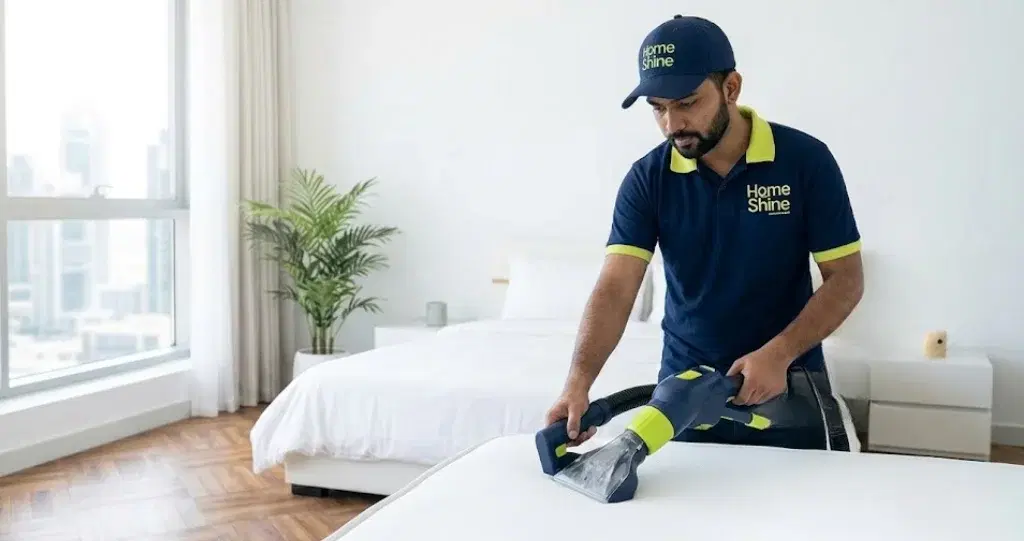
HomeShine technicians bring appropriate equipment and methods for every mattress type, from apartments in Business Bay to villas in Arabian Ranches.
Book your mattress cleaningHow often should mattress cleaning be done in Dubai?
A deep professional clean every six months suits most households. Homes with pets, young children, frequent spills, persistent odours, or specific allergy concerns may benefit from more frequent cleaning.
Can I clean my mattress myself instead of hiring a professional service?
Vacuuming and spot treating minor spills can be done at home, but deep-set stains, persistent odours, suspected mould, and significant allergen buildup may require professional assessment or cleaning equipment that household tools cannot replicate.
Does professional mattress cleaning remove dust mites completely?
Professional mattress cleaning can help reduce dust, allergens, and dust-mite populations, depending on the cleaning method and equipment used. Some providers also offer additional treatments such as UV-C, though ongoing hygiene habits help keep numbers low between cleanings.
How long does a mattress take to dry after professional cleaning?
Depending on the cleaning method, mattress material, humidity, and airflow, a professionally cleaned mattress may dry within several hours. The technician should confirm when the mattress is completely dry and safe to use, particularly when it is dried indoors with the AC running rather than exposed to humid outdoor air.
Is professional mattress cleaning safe for children and pets?
Ask the cleaning provider which products and methods they use, especially if the mattress is used by children, pets, or people with sensitivities. The mattress should be fully dry before use.
Do memory foam mattresses need different cleaning than spring mattresses?
Yes. Memory foam requires more careful moisture control since it absorbs and retains water differently than spring mattresses, which is why professional technicians assess mattress type before choosing an extraction or steam method.